








Andy Fraenkel, a sacred story teller, shows us why India's ancient epic, The Mahabharata, is relevant for us today.
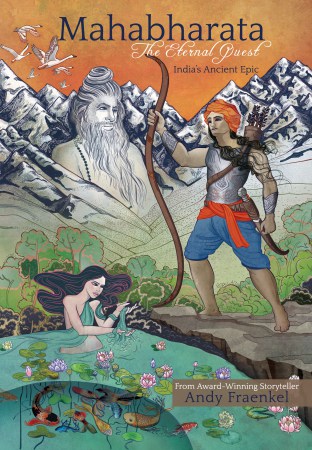
Several years back, as I was bringing my book – Mahabharata: The Eternal Quest – to completion, I kept asking myself: what about the Mahabharata would be most relevant to today’s readers. The book has endured for thousands of years. It’s revered by millions of Hindus all over the world. But what does it have to say to anyone else? Is Mahabharata just for Hindus or does it have a place in world literature, or in the very fabric of our diverse cultures?
The German poet Goethe coined the phrase “world literature” in 1827, and he used it in the context of books transcending national themes. To put it more emphatically, it means literature that speaks to all peoples. Mahabharata is the first of books. The Dharma teachings, the responsibilities of leadership, and warnings of the impending Kali-yuga (our age of darkness) are described as the five thousand year old epic unfolds. It’s not only the first of books, but it’s also the first that can be said to be in the class of world literature. Mahabharata belongs to all of us.
Why? The book itself tells us that what is not found within its pages is found nowhere else. That’s a bold claim to make. Plato commented on two books we consider classical literature – Iliad and The Odyssey. At the time of Plato, those classics were already seven hundred years old. He regarded the books as beautiful poetry and great stories. But he lamented: Where was the philosophy and the moral standards to help guide people to live better lives?
Plato would have liked the Mahabharata. It’s not only good poetry and a great story, but Mahabharata is also the embodiment of dharma. The book exists just to help us understand what is dharma or, in other words, what is our collective moral compass. When we understand the Dharma we can live a life of wellness. That means we live in a balance of both the spiritual and the material. In this way, both the individual and society as a whole prospers.
Dharma has various nuanced meanings. It could mean one’s religion, or occupation, or moral responsibilities to family and society. It could mean ‘the Path.’ On a deeper level, it means who we are and our purpose in life and our eternal relationship with the Divine. All these are addressed in the Mahabharata.
To maintain the Dharma in society requires good leadership. The pillars of Dharma are honesty, compassion, cleanliness and self-sacrifice. In all fields, especially in spirituality, politics and business, leaders need to understand and practice these qualities.
To whom much is given, much is expected. The people who have the most to lose have to make the biggest sacrifices – not just the regular person on the street. The spiritual, political and business leaders have to lead the way. But where is such leadership? This is one of the important generational concerns before us today: to understand what is real leadership and to train leaders who can tackle the formidable challenges of the 21st century. Justice. The environment. The economy. Moral inspiration. We’re mired in some serious problems that are not going to go away soon.
If we don’t know what real leadership is, then it’s a case of the blind leading the blind. Examples of good leadership are very rare in these times. Without it, the philosophy of ‘greed is good’ runs rampant. If the leaders can’t be examples of self-sacrifice, then it becomes OK to give way to our desires, to secure material wealth and pleasure by any means. When we lose sight of the Dharma, greed becomes dominant and society begins to unravel. Understanding the Dharma is pivotal to what Mahabharata is all about.
Andy Fraenkel is a sacred storyteller, workshop leader and author of an award-winning book - www.Mahabharata-project.com